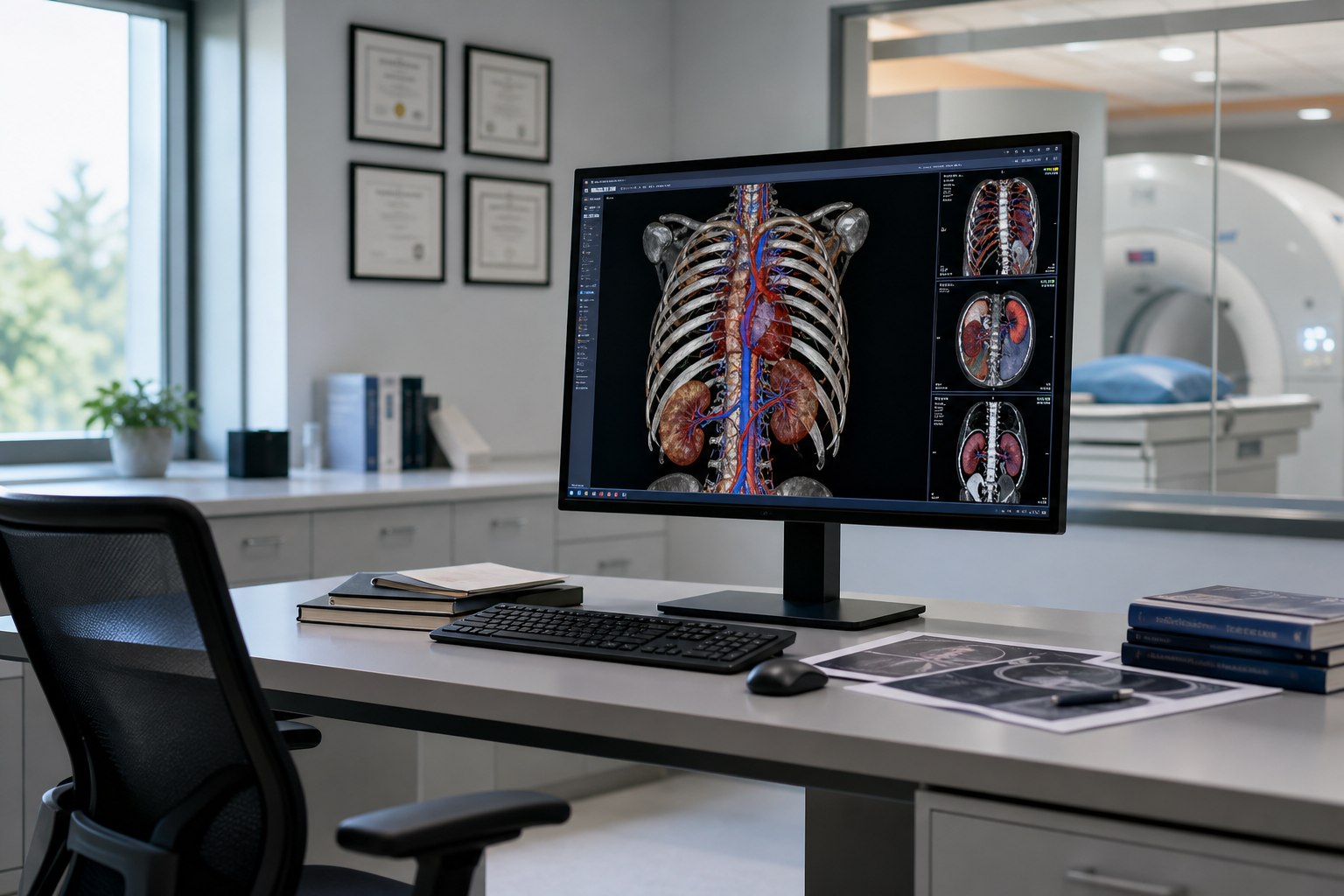
The notice comes from the OEM: your advanced visualization workstation is approaching end of life. An upgrade quote follows, usually in the five or six figures. It has to compete against every other capital request this year.
Nothing is wrong with the workstation. It still processes studies. But support is ending, and now a capability your radiologists depend on needs defending to a capital committee.
Most departments price one option. There are three.
Option 1: Buy the upgrade
Buying is the right call when:
- Volume is high and steady, so fixed costs work in your favor
- You already have two or more trained 3D technologists and low turnover risk
- The platform supports surgical planning, tumor boards, or research where your staff need hands-on control
What the quote does not include:
- Annual service and support
- Software maintenance and version upgrades
- Module licensing. Applications bundled in your original purchase are often licensed separately in the new generation
- IT integration, security review, and validation
- Workstation hardware, on its own refresh cycle
- The technologist who runs it, plus training, certification, PTO coverage, and the gap after they resign
That last line is usually the largest cost of the whole arrangement, and it never reaches the capital committee because it sits in the staffing budget. It is also the most exposed. CT technologist vacancies hit 19.4% in the 2025 ASRT staffing survey. That is the highest of any imaging discipline and an all-time high.
Option 2: Move the work to a partner
Stop owning the capability. Studies route out, trained technologists do the post-processing, results come back to your PACS.
A partner is the right call when:
- Volume is variable or uncertain
- You have one trained technologist, or none
- There is no capital available this fiscal year
- Turnaround already slips whenever someone is out
The objection we hear most is that you would lose access to the software.
You do not. With Precision Image Analysis, your radiologists log into the PIA Cloud and work in the platform directly. They can manipulate the dataset, adjust a measurement, and re-interrogate a finding. They can also reach the technologist assigned to the case inside the software to discuss it.
These are the same platforms a hospital 3D lab runs: TeraRecon, Circle, 3Mensio, Neosoft, SuiteHeart, PIE. Results return appended to the original study as a single series, so they land where your radiologists already read.
Option 3: Bridge the gap
End of life dates and budget cycles almost never line up. A workstation can go unsupported in March when capital cannot be approved until October.
Use a partner for overflow while the capital request moves at its own speed. You keep offering the service, the request stays alive, and you make the permanent decision on a year of real cost and turnaround data instead of a projection.
This is the option most departments skip, and it is frequently the practical one.
What Precision Image Analysis covers
Cardiac functional CTA. Vessel CTA. Coronary arteries. Head, neck, chest. Abdomen and abdominal aorta. Runoff. Pelvis. Upper and lower extremities. Plus FFR, plaque analysis, and calcium scoring. Cardiac, vascular, neuro, oncology and ortho across CT and MR.
Turnaround is published, not described:
- 6 cases per week: 2 to 12 hours
- 12 cases per week: 4 to 24 hours
- 24 cases per week: 8 to 48 hours
- 48 cases per week: 16 to 96 hours
Why this decision is harder than it should be
Most departments cannot say what their current 3D capability costs. The workstation was often bundled into the purchase price of a scanner, so there is no line item. Post-processing is coded into the original study, so the revenue is bundled too.
One health system's 3D lab director estimated the lab cost more than $500,000 to equip and billed over $1 million a year, without being able to isolate either number.
So the upgrade quote gets compared to the capital budget, because there is nothing else to compare it to.
If you are holding one, we will price your actual volume so you have a real number on the other side of the decision.
Speak with an expert